Project / Overview
THE BUILD
BEHIND IT.
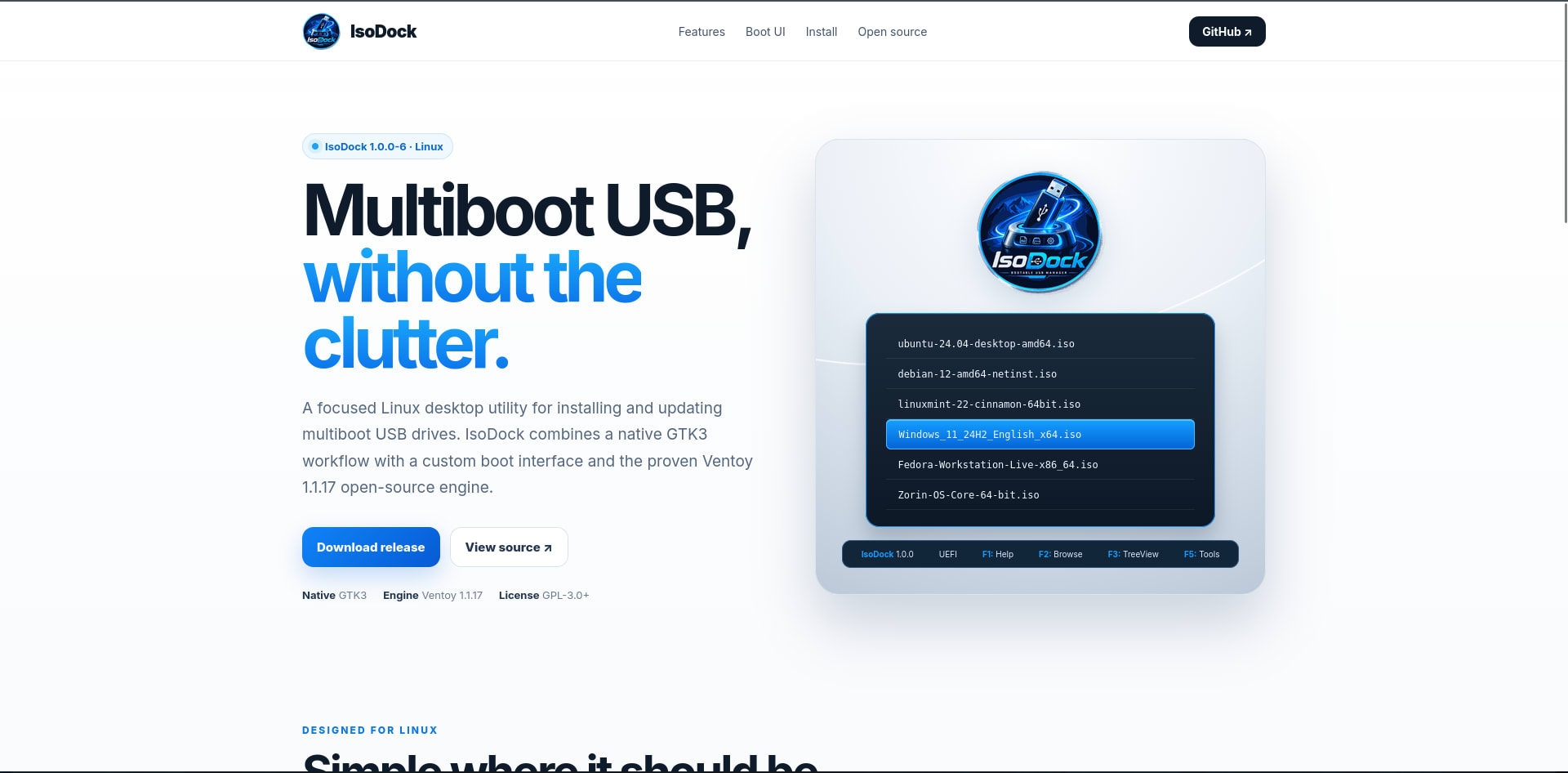
IsoDock is a Linux desktop utility for creating and updating multiboot USB drives through a focused native GTK3 interface. It is designed to make bootable USB management straightforward while providing a distinctive IsoDock boot environment, runtime diagnostics, device validation, and Linux-native packaging.
The project uses Ventoy 1.1.17 as its underlying open-source multiboot engine while adding IsoDock-specific branding, packaging, safeguards, diagnostics, boot-theme customization, and workflow improvements. IsoDock is an independent downstream project and is not affiliated with or endorsed by the official Ventoy project.
Problem
Creating and maintaining multiboot USB drives on Linux can involve fragmented tools, terminal commands, unclear device selection, and interfaces that do not feel integrated with the Linux desktop. Users also need to be especially careful when writing boot data because selecting the wrong storage device can destroy important data.
02 / SolutionSolution
IsoDock provides a focused native Linux interface for installing and updating a multiboot environment on USB drives. It combines device discovery, runtime validation, diagnostics, Debian packaging, and a custom boot experience around the proven Ventoy open-source engine. The goal is to keep the workflow simple while preserving the flexibility required for booting multiple operating-system images from one drive.
03 / ChallengeChallenge
The biggest challenge was integrating a reliable existing multiboot engine without breaking its compatibility assumptions. Rebranding had to be separated from internal engine identifiers, and the boot interface needed to remain compatible with BIOS and UEFI environments. Additional work was required to handle Linux mount points safely, including paths containing spaces, package the complete runtime, verify boot-image integrity, and preserve upstream licensing and attribution.
04 / OutcomeOutcome
IsoDock 1.0.0-6 became the first production-candidate release of the project. It includes a native GTK3 interface, Debian package, custom silver-and-blue boot theme, dynamic ISO listing, runtime integrity checks, built-in diagnostics, improved USB unmount handling, open-source documentation, and a dedicated public project website. Automated source, packaging, runtime, branding, and regression checks pass, with broader physical hardware testing remaining part of the release-validation process.