Project / Overview
THE BUILD
BEHIND IT.
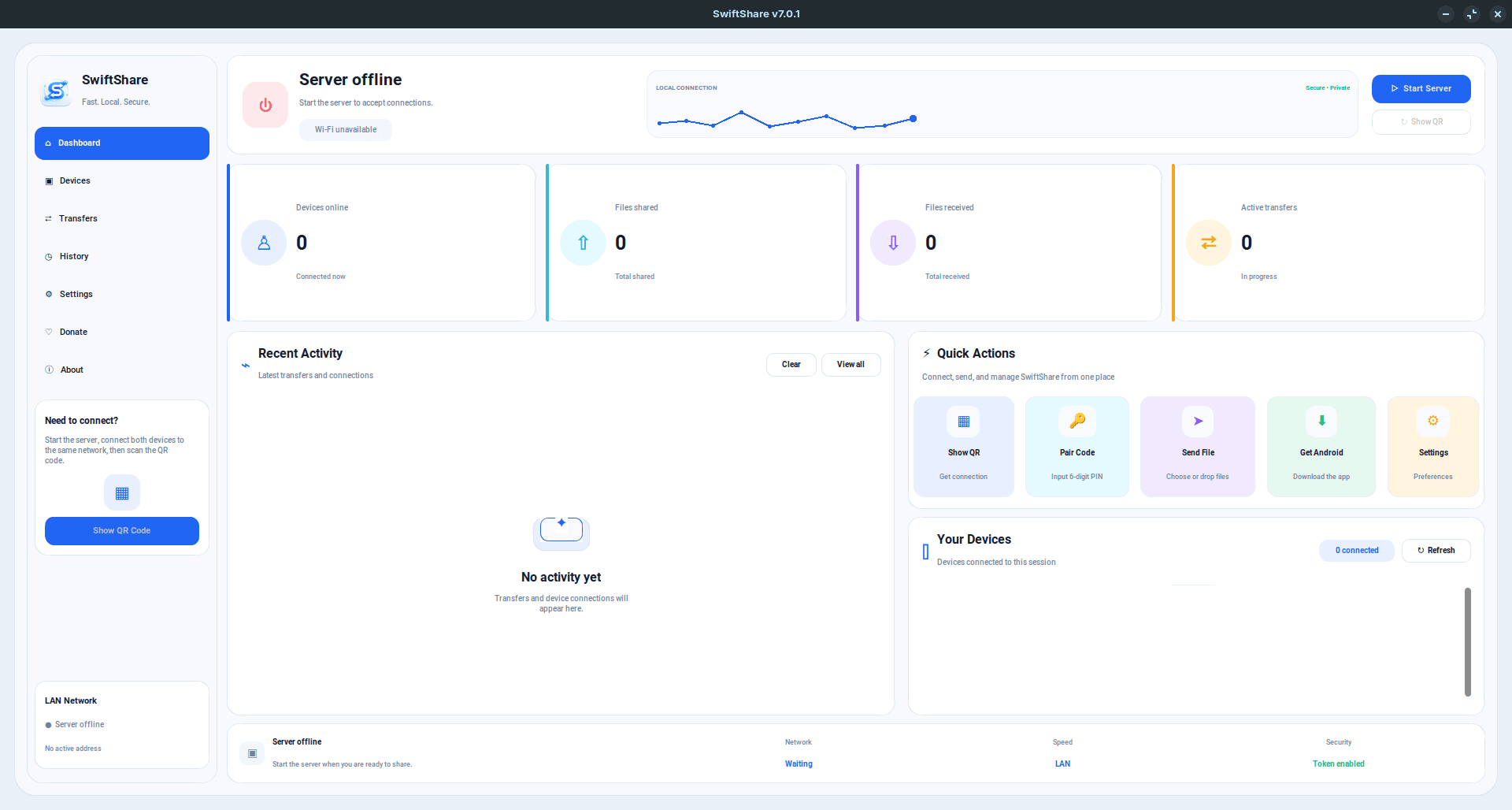
SwiftShare is a cross-platform file transfer system built for fast, direct, and understandable device-to-device sharing. It supports Windows, Linux, Android, and browser-based workflows with local-network discovery, QR and six-digit pairing, visible transfer progress, integrity verification, and platform-specific installers. The project focuses on keeping transfers local whenever possible while adding practical security controls such as HTTPS, certificate fingerprint pinning, rate-limited pairing, safe receive paths, and SHA-256 verification.
Problem
Moving files between phones and computers often requires cloud uploads, user accounts, USB cables, messaging apps, or platform-specific tools. These approaches can add unnecessary steps, depend on internet access, reduce privacy, or make large local transfers inconvenient.
02 / SolutionSolution
SwiftShare provides a local-first transfer workflow that lets nearby devices discover and pair with each other, then move files directly across the local network. It combines QR pairing, six-digit pairing, visible transfer progress, desktop and Android clients, browser access, integrity checks, and platform-specific installers in one cross-platform system.
03 / ChallengeChallenge
The main challenge was keeping pairing, security, transfer behavior, and user experience consistent across Windows, Linux, Android, and browser environments. Each platform handles networking, storage permissions, TLS certificates, background services, packaging, and firewalls differently, so the project required careful protocol design, failure handling, security hardening, and repeatable release workflows.
04 / OutcomeOutcome
SwiftShare evolved into a working cross-platform transfer product with dedicated desktop and Android builds, local-network discovery, secure pairing, certificate pinning, SHA-256 integrity checks, safer file handling, transfer progress, and installable Linux and Windows release paths. Security hardening also added stricter credential handling, rate limiting, secure browser sessions, signed-update foundations, and regression tests for critical transfer controls.